
You walk into a hotel lobby. And you instantly felt something had changed right then.
The air feels different. The ceiling surprises you. The light sits low and warm somewhere to the side. Without anyone saying anything, the space seems to already know what you need.
You stand there longer than necessary, eyes on nothing specific, and somehow that feels like exactly the right thing to do.
The feeling in that lobby was a decision somebody made before the building existed. Not a decision about materials or ceiling height or where the light should sit. A decision about a person. About what that person would need the moment they stopped moving. Everything else was built around the answer.
This is Experience Design, the practice of making feelings intentional.
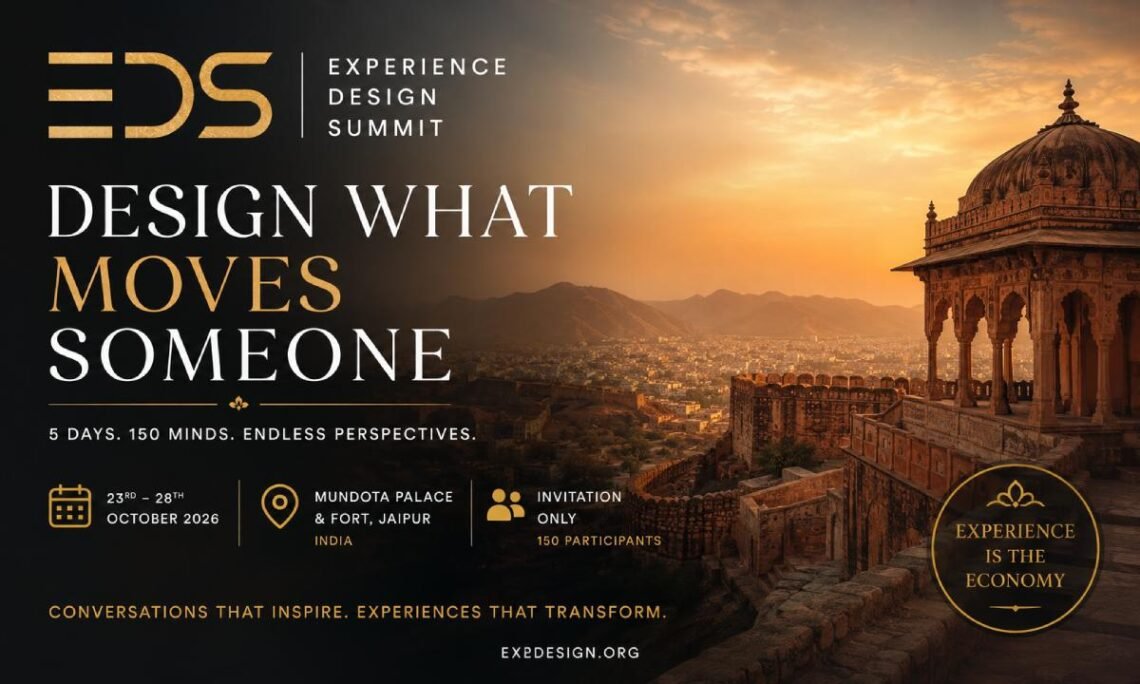
The Experience Design Summit India (EDS) is a five-day residential gathering dedicated to experience design. It will take place from 23–28 October 2026 at Mundota Palace & Fort, Jaipur.
What is Experience Design?
A space makes you feel something. So does a story, a brand, a moment. Experience design is the work of deciding what a response should be, and building everything around that decision.
Experience Design does not sit inside any one field, and that is not a gap in the discipline. A person inside a space is not separating the light from the sound or the sound from the story. It is all one thing landing at once.
Experience design borrows from architecture, storytelling, sensory science, psychology, and cultural theory. Which means every experience that did not ask that question still gave someone a feeling.
At its most essential, experience design is about transformation. The before and the after. The version of a person who walks out of a space or a story or an encounter and is, in some way, different from who walked in. EDS exists for the people who find that gap interesting and want to understand how to create it deliberately.
Why Experience Design is the need of the hour?
We are living through a quiet shift in what people actually want.
Products were the economy once. Then services. Then, content, delivered faster and cheaper than anyone imagined possible. Now, what moves people and markets is experience.
Nobody changed how they travel or where they eat because they read about experiential economics. They changed because something, somewhere, made them feel awake in a way they had not expected. The organizations that understand this are building something that outlasts the product.
For a discipline that runs underneath every industry touching human life – hospitality, tourism, luxury, retail, live culture, public space, brand – experience design as a deliberate, collaborative practice is still, somehow, making the case for itself.
The reason “experience is the economy” keeps feeling true because people recognize it from their own lives. The world is not short on content, options, or convenience. What it is short on is the feeling of having been somewhere that actually mattered. That gap is where experience design lives. And right now, that gap is very large.
The elements that make up Experience Design
Part of understanding what is Experience Design is realizing that it does not live in any one element. It is always a composition.
Space and atmosphere are often where it begins. No story needs to be told for a space to make a person feel something. The room is already working. Its proportions, the source and warmth of its light, the way it handles sound, and the subtle pressure of whether it opens the body or closes it: all of this lands before conscious thought catches up.
Mundota Palace & Fort in Jaipur, a 500-year-old estate above the plains of Rajasthan where EDS 2026 takes place is itself a study in this. The stone, the battlements, the quality of silence in certain corridors: these were not designed last year. They are design decisions made across centuries that still produce a feeling in the person who walks through them today.
Story and narrative are the invisible architecture. Spaces carry more meaning when they carry a story. Brands become unforgettable when they have a mythology. An experience designer thinks in sequence, in revelation, in the order in which things are understood and felt. Narrative can be felt in sequence, in curation, in the order in which things are revealed.
Sensory design is where experience design goes deepest and where most design processes still stop short. Sound changes the emotional temperature of a room. Scent opens memory in ways that nothing else does. Light is mood, direction, and time of day.
Human connection is what most experiences are, at bottom, really about. The most technically perfect environment falls flat if the people inside it are not given the conditions to actually connect with the space, with an idea, and with each other.
Experience Design across industries
In hospitality and luxury, it is the difference between a hotel that is objectively excellent and one that you talk about for the rest of your life. The former delivers what was promised. The latter delivers something that was never written in the brochure. It is the invisible decisions: the light in the lobby at six in the evening, the way the staff speak, the quality of silence etc
In cultural tourism and destination design, it is the difference between a place that has remarkable things in it and a place that is itself remarkable. The story a city tells. The way a fort receives a visitor. The quality of encounter with something ancient.
In brand and culture, some brands become part of how their audience sees themselves. Most don’t. The difference is rarely the product. It is whether the brand ever understood that what people remember is never what they were told. It is what they felt and when.
In live events and immersive storytelling, it is the entire practice. Sleep No More did not just push the boundaries of live performance. It got rid of them entirely, pulling the person who came to watch into the same space and the same story as the thing they were watching.
What Experience Design is not
Understanding what is Experience Design also means understanding what it is not. Beautiful things that do not produce feelings are not Experience Design. They are aesthetics.
It is not UX in the product sense, though digital experience is a part of the broader field. Experience design asks about the whole arc also whether the journey means anything.
It is not control. The paradox that most experience designers eventually run into: the tighter you hold a moment, the less it feels like one. The experiences people carry for years are almost never the ones that went exactly as planned. They are the ones where something unscripted happened.
And centrally, it is not a single person’s work. They work across architecture, sound, storytelling, psychology, technology, and human behaviour.
Where is the conversation happening?
If experience design is the discipline of the moment, then the people who practise it need a room. A room where a hospitality leader, a theatre director, a cultural curator and an architect can spend five days actually thinking together.
That is what the Experience Design Summit India is built around. 150 practitioners. One location that has been holding people for five centuries- Mundota Palace & Fort in Jaipur. one of the most considered pieces of spatial design in Rajasthan.
Twelve faculty members. Twelve completely different careers. One question running through all of them – how do you make someone feel something that stays with them?
Five days inside the fort, with these people, is the programme.
EDS does not describe itself as a conventional Experience Design Conference, and the distinction is worth holding onto. Experience design is the discipline that takes seriously what most industries still treat as secondary: the feeling. EDS is where that conversation finally gets the space it has always needed.
Applications for EDS 2026 are open now. Attendance is limited to 150 curated participants. To inquire or begin your application, write to explore@expdesign.org or visit expdesign.org.
23rd to 28th October 2026. Mundota Palace & Fort Jaipur , India,
Frequently asked questions
What is Experience Design?
Experience design is the practice of making feelings intentional. Deciding in advance what a person should walk away with, and building everything around that decision.
What is the Experience Design Summit India?
The Experience Design Summit India is a five-day residential programme at Mundota Palace & Fort in Jaipur, bringing together 150 practitioners and 12 faculty members from hospitality, storytelling, architecture, and culture. It is where the work that most conferences only talk about actually gets done.
When and where is EDS 2026?
EDS 2026 takes place from 23rd to 28th October 2026 at Mundota Palace & Fort, Jaipur, India.
Who is EDS for?
It is for practitioners who work across hospitality, luxury, live events, cultural tourism, brand, and design and have spent their careers knowing that experience is not a trend. It is the work.
How do I apply for EDS 2026?
EDS is limited to 150 curated participants. To apply, write to explore@expdesign.org or visit expdesign.org.

