
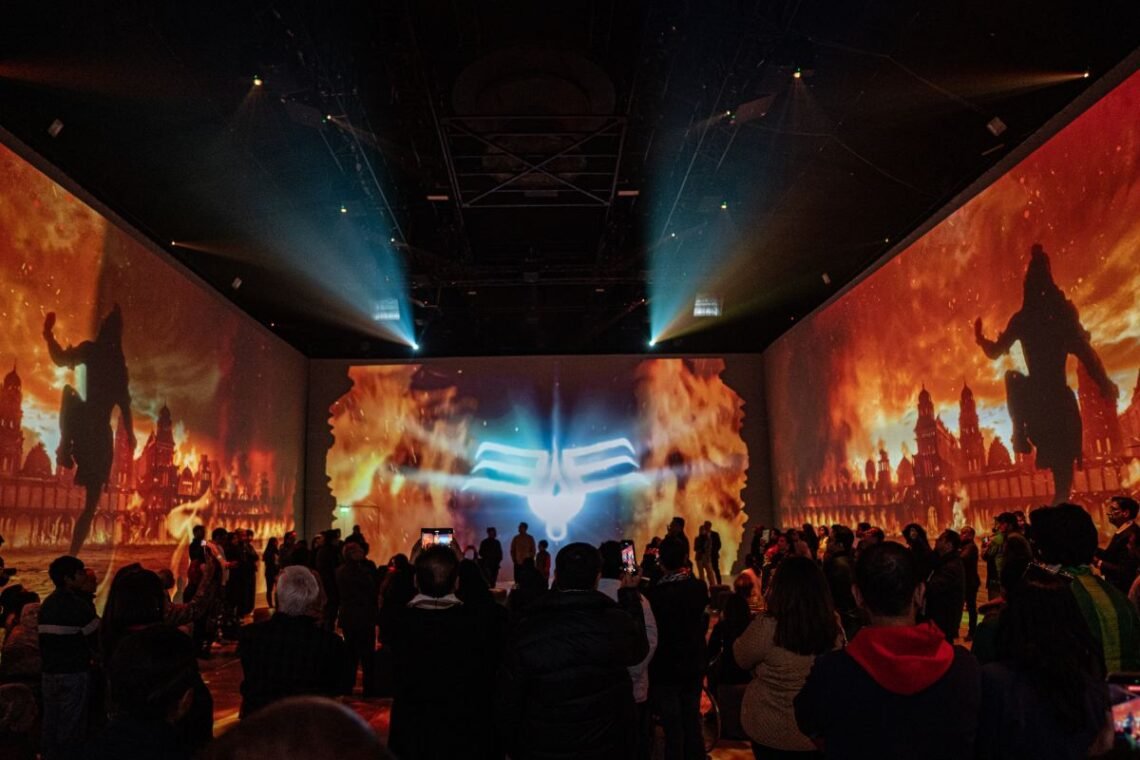
What happens when one of India’s oldest spiritual narratives meets 360° projection, spatial sound, laser, light, haze, and virtual reality?
The answer is Shiva Immersive, a three-zone experiential journey in Noida that brings the world of Shiva into a contemporary, technology-driven environment. Instead of presenting mythology as something to simply watch or read, the experience places visitors inside the narrative, allowing them to move through sound, light, movement, virtual reality, and finally, silence.
Located at GIP Mall, Sector 38, Noida, Uttar Pradesh, Shiva Immersive is designed as an approximately 60-minute experience divided into three distinct zones: the Immersive Experience, the VR Experience, and the Reflection Zone.
Each zone has a different purpose. The first surrounds visitors with an expansive visual and sensory narrative. The second takes them on a virtual journey towards Kailash. The final zone slows everything down and creates space for reflection.
Together, these three stages form a journey that moves from spectacle to exploration and finally to stillness.
What Is Shiva Immersive?
Shiva Immersive is an experiential attraction that combines Indian mythology with immersive entertainment technology.
At its heart is the story and symbolism associated with Shiva, one of the most significant figures in Indian spiritual and cultural traditions. Rather than presenting that story through a conventional theatre format, Shiva Immersive uses a combination of 360° projection, spatial sound, lighting, laser effects, haze, virtual reality, and atmospheric design.
The result is intended to make the visitor feel surrounded by the narrative.
This distinction is important. A conventional show places the audience in front of a stage. An immersive experience attempts to remove that clear separation between the audience and the story.
At Shiva Immersive, the visitor enters the environment itself.
The experience is divided into three zones, and each one changes the way the story is experienced.
The Three Zones of Shiva Immersive
The structure of Shiva Immersive is one of its most interesting elements. Rather than making the entire experience a continuous projection show, it creates three different stages of engagement.
The first is expansive and sensory. The second is personal and technological. The third is quiet and contemplative.
This progression creates a natural movement through the experience.
You first encounter Shiva’s universe through immersive storytelling. You then travel into the landscapes associated with Kailash through virtual reality. Finally, the external spectacle gives way to an environment designed around stillness.
It is almost like moving from story to journey to reflection.
The Immersive Hall: Entering the World of Shiva
The first zone is the heart of the experience.
From the threshold, visitors move into the Immersive Hall, where the surroundings become part of the storytelling environment. The space uses 360° projection, spatial sound, laser, lights, and haze to create a continuous visual and sensory narrative.
For approximately 28 minutes, the audience is surrounded by the world of Shiva.
There is no conventional screen that separates the visitor from the story. Instead, imagery can extend across the environment, allowing the narrative to unfold around the audience.
This changes the relationship between viewer and story.
Rather than sitting outside the narrative and observing it from a distance, visitors become physically present within the designed environment. Visuals surround them, sound occupies the space, and lighting contributes to the atmosphere.
The technology is therefore not simply being used for visual spectacle. It becomes a storytelling language.
When Mythology Becomes an Experience
One of the most compelling aspects of Shiva Immersive is the way it approaches mythology.
Indian mythology contains enormous visual, philosophical, and symbolic depth. Translating that material into a contemporary experience presents a unique creative challenge.
A story that has traditionally been transmitted through scriptures, oral traditions, literature, art, dance, television, cinema, and temple culture is now being interpreted through immersive technology.
This allows familiar ideas to be experienced through a different sensory language.
The scale of projection can create a sense of vastness. Sound can establish atmosphere. Light can alter the emotional character of a scene. Movement can make a story feel alive.
The result is not simply a technological presentation of mythology.
It is an attempt to create an environment in which mythology can be felt as an experience.
360° Projection and the Power of Immersive Storytelling
Traditional cinema controls where the audience looks. A rectangular screen defines the boundaries of the visual world.
Immersive projection works differently.
When imagery extends around the visitor, the environment itself becomes part of the canvas. The audience can feel surrounded by the story rather than positioned outside it.
At Shiva Immersive, this approach is combined with spatial sound, lighting, laser, and haze.
The combination matters because immersion is rarely created by one technology alone.
A large projection may create scale, but sound gives that scale atmosphere. Lighting can shift attention and emotion. Haze can make beams of light visible within the physical space. Spatial audio can make the environment feel larger than the room itself.
Together, these elements help transform a physical hall into another world.
The VR Experience: A Journey Towards Kailash
After the immersive hall, the experience changes character.
Visitors enter the VR Experience, a seven-minute virtual reality journey that takes them towards the mystical landscapes of Kailash Parvat.
Virtual reality introduces a different kind of immersion.
In the Immersive Hall, the environment surrounds the visitor physically. In VR, the headset creates a digitally constructed world that the visitor explores from within.
This makes the experience more intimate.
The journey to Kailash is not simply represented as a distant geographical destination. Through VR, visitors are invited to experience a digitally created interpretation of a landscape that occupies an important place in Shiva’s mythology and spiritual imagination.
The technology becomes a bridge between the physical world and an imagined realm.
When Technology Opens a Window Into the Unseen
The VR section of Shiva Immersive demonstrates how technology can be used for more than entertainment.
Virtual reality can create environments that would otherwise be difficult or impossible for audiences to access.
A visitor in Noida can put on a headset and enter an interpretation of a place associated with immense scale, spirituality, mythology, and natural grandeur.
The physical distance disappears for a few minutes.
That is where the experience becomes more than a visual journey. The combination of virtual environment and mythology encourages the visitor to imagine a place that exists simultaneously in geography, culture, scripture, and spiritual thought.
The result is intended to feel like an ascent rather than simply a change of scenery.
The Reflection Zone: When the Noise Stops
After the visual intensity of the immersive show and the VR journey, Shiva Immersive changes completely.
The Reflection Zone, lasting approximately 15 minutes, is designed around stillness.
Visitors enter an environment described as an infinite field of stars surrounding a single glowing cosmos. The atmosphere becomes quieter and more contemplative.
This is where the three-zone structure becomes especially meaningful.
The experience begins with movement, sound, scale, light, and visual stimulation. It then takes visitors into a virtual journey. Finally, it removes much of that external stimulation.
The emphasis shifts from what is happening around the visitor to what the visitor may experience internally.
The story is no longer simply unfolding in front of you.
It begins to unfold within you.
Why the Reflection Zone Matters
A common assumption about immersive entertainment is that more stimulation automatically means a better experience.
Shiva Immersive takes a different approach.
The Reflection Zone demonstrates that silence can be just as powerful as spectacle.
After spending nearly half an hour surrounded by projection, sound, light, and visual storytelling, the sudden change of pace creates contrast. That contrast can make the final stage feel particularly significant.
The glowing cosmos becomes a focal point rather than another visual effect competing for attention.
The visitor is given time to slow down.
In this sense, the Reflection Zone completes the journey by introducing something that technology often struggles to create: stillness.
Shiva Immersive Is More Than a Visual Show
Calling Shiva Immersive simply a visual show would not fully describe the experience.
The projections are certainly a major part of it, but the overall design combines several layers.
There is mythology and storytelling. There is sound and music. There is architectural space. There is lighting. There is virtual reality. There is atmosphere. And finally, there is reflection.
Each element contributes to a different emotional stage.
This is what makes the experience closer to an immersive journey than a conventional theatrical performance.
Visitors are not expected to remain passive throughout the entire experience. They move between environments, change modes of engagement, and experience the story through different sensory formats.
The Connection Between Shiva and Stillness
The final stage of Shiva Immersive also connects with one of the central ideas associated with Shiva: stillness at the centre of creation.
The experience deliberately moves from external movement toward internal quiet.
The Immersive Hall is expansive and energetic. The VR journey creates a sense of exploration and ascent. The Reflection Zone becomes calm and inward-looking.
This structure gives the experience an emotional arc.
It is not simply about showing visitors what Shiva looks like or presenting mythological imagery on a large screen. It attempts to explore the atmosphere and ideas associated with Shiva through the language of immersive design.
The final moment therefore does not need to be louder than the beginning.
It can be quieter.
How Long Does Shiva Immersive Take?
The complete Shiva Immersive experience lasts approximately 60 minutes across its three zones.
The main Immersive Experience lasts around 28 minutes.
The VR Experience lasts approximately 7 minutes.
The Reflection Zone lasts approximately 15 minutes.
The remaining time can account for movement and transitions between the different stages of the experience.
Because the three zones have different formats, the approximately one-hour duration does not feel like a single continuous show. Instead, it is structured as a sequence of experiences.
Where Is Shiva Immersive Located?
Shiva Immersive is located at:
GIP Mall, Sector 38, Noida, Uttar Pradesh – 201301
Visitors should use Gate 9 for entry to the experience.
The location makes Shiva Immersive accessible to visitors from Noida and the wider Delhi-NCR region.
Shiva Immersive Timings
Shiva Immersive offers slots throughout the day, with available timings listed from approximately 12:30 PM to 8:30 PM.
The exact experience time should be selected when purchasing tickets, so visitors should check their booking details before arriving.
Because immersive experiences often operate through scheduled entry slots, arriving according to the selected time can help ensure a smoother visit.
Who Can Experience Shiva Immersive?
The experience is designed to be suitable for a wide range of visitors and is listed as suitable for all ages.
Children under five years can enter free of charge according to the provided information.
The venue is also described as wheelchair accessible, making the experience more accessible to visitors with mobility requirements.
As with any immersive attraction, visitors should review the experience’s current terms and conditions and FAQs before booking.
Why Shiva Immersive Is Different
There are many entertainment experiences built around projection and technology, but Shiva Immersive attempts to connect technology with something deeper.
The experience does not use technology simply to make images larger.
Instead, different technologies serve different parts of the journey.
Projection creates the world.
Sound gives it atmosphere.
Light shapes the environment.
Haze adds physical depth to the lighting.
VR creates a journey into another realm.
The Reflection Zone removes the intensity and gives the visitor space to pause.
That sequence gives the experience a clear identity.
A Journey From Spectacle to Stillness
Perhaps the simplest way to understand Shiva Immersive is to look at its progression.
It begins with spectacle.
The visitor enters a large immersive environment where story, projection, sound, light, and atmosphere work together.
It then moves into exploration.
Virtual reality takes the visitor towards Kailash and creates a more individual experience of the imagined landscape.
Finally, it reaches stillness.
The Reflection Zone places the visitor beneath a field of stars around a glowing cosmos and allows the intensity of the earlier stages to settle.
This progression gives Shiva Immersive an unusual rhythm.
It does not keep increasing the volume until the end.
Instead, it eventually becomes quiet.
What Can Visitors Take Away From Shiva Immersive?
The answer will naturally differ from person to person.
For some visitors, the attraction may be primarily a visually impressive interpretation of Shiva and Indian mythology. For others, the VR experience may be the most memorable part. Some may connect most strongly with the Reflection Zone.
That variety is part of what makes immersive experiences interesting.
The same environment can create different emotional responses in different people.
A child may be fascinated by the technology. A mythology enthusiast may focus on the narrative. A technology enthusiast may appreciate the projection and VR systems. Someone seeking a quiet moment may connect most deeply with the final reflection experience.
The experience leaves room for all of these interpretations.
Shiva Immersive: Where Ancient Stories Meet New Technology
Shiva Immersive represents an interesting meeting point between heritage and contemporary experience design.
The stories and symbolism surrounding Shiva come from an ancient cultural tradition, while the tools used to present them include some of the most contemporary forms of immersive entertainment.
That combination creates a bridge between two very different worlds.
One is rooted in mythology, spirituality, symbolism, and timeless narratives.
The other is rooted in projection technology, virtual reality, spatial audio, lighting, and experiential design.
Shiva Immersive brings them together in one physical journey.
Final Thoughts
Shiva Immersive is not simply a show about Shiva. It is a journey designed around the feeling of entering a story.
From the 360° Immersive Hall to the virtual journey towards Kailash and the quiet Reflection Zone, each stage offers a different way of engaging with the narrative.
The experience begins with the outside world becoming extraordinary.
It moves through technology into an imagined realm.
And finally, it becomes still.
That final transition may be the most important part of the entire experience.
After the projections disappear, the VR headset comes off, and the sound settles, what remains is a visitor standing beneath an infinite field of stars around a single glowing cosmos.
The story stops unfolding around you.
And begins unfolding within.
Frequently Asked Questions About Shiva Immersive
What is Shiva Immersive?
Shiva Immersive is a three-zone experiential attraction in Noida that combines the stories and symbolism of Shiva with 360° projection, spatial sound, lighting, laser, haze, virtual reality, and a dedicated reflection environment.
Where is Shiva Immersive located?
Shiva Immersive is located at GIP Mall, Sector 38, Noida, Uttar Pradesh 201301. Entry is through Gate 9.
How long is the Shiva Immersive experience?
The complete experience takes approximately 60 minutes across the Immersive Experience, VR Experience, and Reflection Zone.
What are the three zones of Shiva Immersive?
The three zones are the approximately 28-minute Immersive Experience, the approximately 7-minute VR Experience, and the approximately 15-minute Reflection Zone.
What happens in the Immersive Experience?
Visitors enter a 360° environment where projection mapping, spatial sound, lights, laser, and haze combine to create an immersive interpretation of Shiva’s world and mythology.
What is the VR Experience at Shiva Immersive?
The VR section is an approximately seven-minute virtual reality journey that takes visitors into an interpretation of the mystical landscapes of Kailash Parvat.
What is the Reflection Zone?
The Reflection Zone is the final stage of the experience. It creates a quiet environment featuring an infinite field of stars and a glowing cosmos, encouraging visitors to slow down and reflect after the immersive and VR experiences.
Is Shiva Immersive suitable for children?
The experience is listed as suitable for all ages, with children under five years able to enter free according to the provided information. Visitors should check the current terms and conditions before booking.
Is Shiva Immersive wheelchair accessible?
Yes. The provided venue information states that the experience is wheelchair accessible.
What are the timings for Shiva Immersive?
Slots are available daily from approximately 12:30 PM to 8:30 PM. Visitors select their preferred time while purchasing tickets.
Is Shiva Immersive only about technology?
No. Technology is an important part of the experience, but Shiva Immersive also focuses on mythology, storytelling, atmosphere, emotion, and reflection. The experience combines these elements rather than relying solely on visual effects.
What makes Shiva Immersive different from a normal theatre show?
A conventional theatre show generally places the audience in front of a stage. Shiva Immersive surrounds visitors with the story through 360° projection and environmental effects, then takes them into VR before concluding with a dedicated reflection space.
Where can visitors enter GIP Mall for Shiva Immersive?
The provided information states that visitors should enter through Gate 9 at GIP Mall, Sector 38, Noida.
Why is the Reflection Zone important?
The Reflection Zone provides a deliberate contrast to the visual and sensory intensity of the first two stages. It gives visitors an opportunity to slow down, experience stillness, and interpret the journey personally.