
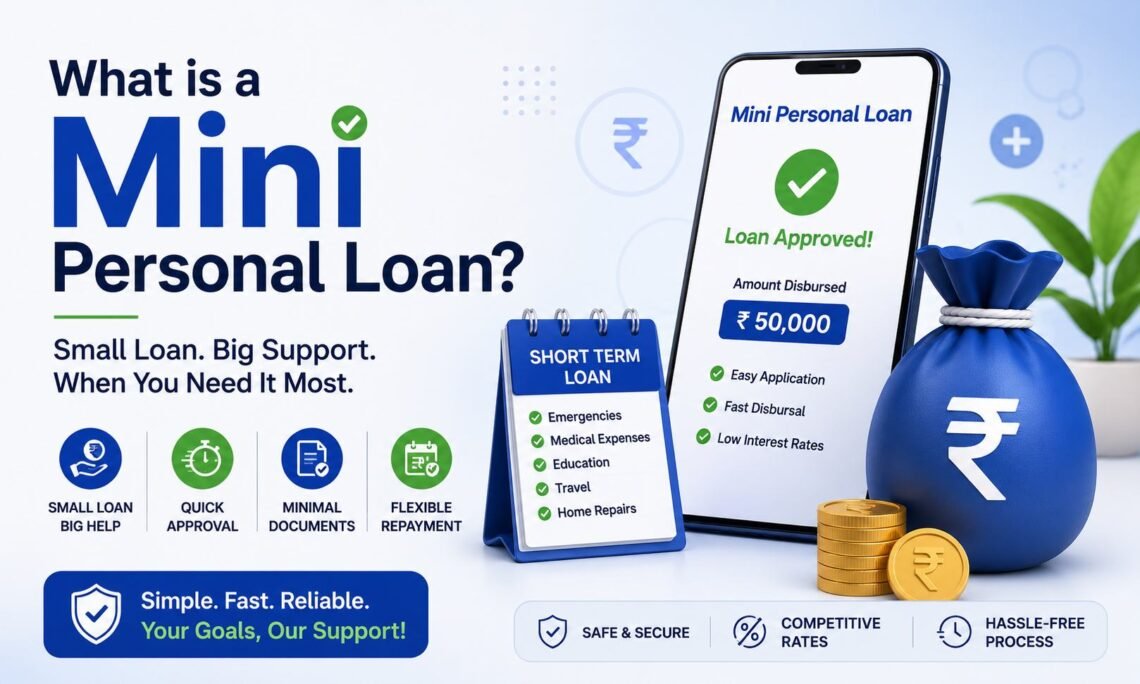
When an unexpected expense appears, you may not always need a large loan. Sometimes, a relatively small amount is enough to manage an urgent payment, cover a short-term expense, or handle a temporary cash-flow gap. This is where a mini personal loan can be useful.
A mini personal loan is generally a small-value personal loan designed for borrowers who need a limited amount of money for a short-term financial requirement. Depending on the lender, these loans may have shorter repayment periods and a simpler application process compared with larger borrowing products.
However, borrowers should not assume that a small loan is automatically a low-cost loan. Interest rates, processing fees, late-payment charges, and other terms can vary significantly between lenders. Understanding the complete cost and repayment obligation is important before accepting any loan.
What Is a Mini Personal Loan?
A mini personal loan is a relatively small unsecured loan that can be used for personal financial needs. Unlike a home loan or vehicle loan, the money is generally not restricted to purchasing a specific asset.
The amount available depends on the lender and the borrower’s eligibility. Some lenders may offer small personal loans through digital platforms, while banks and financial institutions may provide similar small-ticket credit products under different names.
Because these loans are usually unsecured, lenders may evaluate factors such as income, credit history, repayment capacity, employment or business stability, and existing financial obligations before making a lending decision.
How Does a Mini Personal Loan Work?
The process is generally similar to other personal loans. A borrower applies for a specific amount, provides the information and documents requested by the lender, and goes through an eligibility and verification process.
If the application is approved, the lender provides the loan according to the agreed terms. The borrower then repays the principal and applicable interest through scheduled installments.
The exact process can vary between lenders. Some digital lenders may provide an online application process, while traditional financial institutions may use their own application and verification procedures.
Why Do People Take Mini Personal Loans?
A small personal loan may be considered when someone has a temporary financial requirement and does not need a large amount of credit.
For example, a borrower may need money for an urgent household expense, a minor repair, an education-related payment, travel, a medical expense, or another legitimate personal requirement.
The important point is to borrow only what is actually needed. Taking a larger loan simply because a higher amount is available can increase the total repayment burden.
What Are the Main Features of a Mini Personal Loan?
Mini personal loans generally focus on smaller borrowing amounts and relatively straightforward repayment structures. Depending on the lender, borrowers may find digital applications, shorter repayment periods, flexible loan amounts, and quicker processing.
However, these features are not universal. A lender may have specific eligibility requirements, documentation requirements, interest rates, fees, and repayment terms.
Before choosing a loan, borrowers should compare the actual terms rather than relying only on advertisements describing a loan as “instant,” “easy,” or “quick.”
Is a Mini Personal Loan an Unsecured Loan?
In many cases, a mini personal loan is an unsecured form of borrowing, meaning the borrower does not pledge an asset as collateral.
Because there is no collateral backing the loan, the lender may rely more heavily on the borrower’s creditworthiness and repayment capacity.
This is why a borrower’s credit history, income, existing debt, and other financial information can influence approval and loan terms.
Can You Get a Mini Personal Loan With a Low CIBIL Score?
Possibly, but approval depends on the lender’s eligibility criteria and the borrower’s complete financial profile.
A low CIBIL score can make borrowing more difficult and may result in higher interest rates, lower loan amounts, or stricter conditions. Some lenders may consider additional factors such as income, banking history, employment stability, and existing repayment behavior.
There is no universal rule that guarantees approval based on a particular CIBIL score.
What Documents May Be Required?
The documentation required depends on the lender and the applicant’s profile. Commonly requested information can include identity details, address information, income-related documents, bank account information, and employment or business details.
Digital lenders may also use electronic verification methods.
Applicants should provide information only through legitimate and secure channels and should understand why a lender is requesting specific information.
How Much Does a Mini Personal Loan Cost?
The cost of a mini personal loan depends on several factors, including the principal amount, interest rate, repayment tenure, processing fee, taxes where applicable, and other charges specified in the agreement.
A small principal amount does not necessarily mean that the loan will have a small overall cost.
For example, a loan with a short tenure may have a manageable total interest amount but a relatively high monthly repayment. A longer tenure can reduce the monthly installment but may increase the total interest paid.
Always consider the total repayment amount, not just the advertised EMI.
What Is the Difference Between a Mini Personal Loan and a Regular Personal Loan?
The main difference is usually the loan size and the borrower’s financial requirement.
A regular personal loan may involve a larger amount and a longer repayment period, while a mini personal loan generally focuses on smaller short-term requirements.
Both can be unsecured and both may require credit and income assessments. The exact distinction depends on how a particular lender defines its product.
Mini Personal Loan vs Credit Card
A credit card provides a revolving line of credit, while a personal loan provides a fixed amount that is generally repaid through scheduled installments.
For a small financial requirement, a credit card may sometimes be convenient, especially if the borrower can repay the balance within the applicable interest-free period. However, carrying a credit card balance can become expensive if interest and other charges accumulate.
A mini personal loan may provide a fixed repayment structure, which can make budgeting easier.
The better option depends on the cost, repayment period, and borrower’s financial circumstances.
What Are the Benefits of a Mini Personal Loan?
A small personal loan can provide access to funds when the borrower has a genuine short-term requirement.
It can also offer a predictable repayment schedule, allowing the borrower to plan monthly finances more easily. Some lenders may provide online applications and digital processing, which can make the application experience more convenient.
However, convenience should not be the only consideration. The borrower should also compare interest rates, fees, lender credibility, and repayment terms.
What Are the Risks of Mini Personal Loans?
The biggest risk is borrowing without understanding the complete cost.
Some short-term or small-ticket loans may have relatively high interest rates or additional charges. Late repayment can also result in penalties and may negatively affect your credit history.
Another risk is taking one loan to repay another. Repeated borrowing can create a cycle in which the borrower continuously takes new credit to manage existing obligations.
A mini personal loan should therefore be used carefully and only when the repayment plan is realistic.
How Can You Choose the Right Mini Personal Loan?
Start by identifying exactly how much you need and how quickly you can repay it. Then compare legitimate lenders based on interest rates, processing fees, tenure, EMI, late-payment charges, prepayment terms, and the total repayment amount.
Check the lender’s eligibility criteria before applying.
You should also read the loan agreement carefully and make sure you understand every applicable charge before accepting the offer.
Is a Mini Personal Loan Good for Emergencies?
It can be useful for a genuine short-term emergency if the borrower has a reliable repayment plan.
However, borrowing during an emergency can sometimes lead to rushed decisions. Before accepting a loan, compare the available options and consider whether existing savings or another lower-cost financial option can cover the expense.
The goal should be to solve the immediate financial requirement without creating a larger financial burden later.
How Can You Repay a Mini Personal Loan Responsibly?
The best approach is to plan the repayment before taking the loan.
Calculate the monthly installment and compare it with your regular income and existing expenses. Make sure the EMI remains manageable even if an unexpected expense occurs.
Set reminders for payment dates or use an appropriate automatic payment arrangement. Avoid delaying payments because late repayment can result in additional charges and may affect your credit history.
Frequently Asked Questions About Mini Personal Loans
What is a mini personal loan?
A mini personal loan is generally a small-value unsecured loan intended to meet short-term personal financial requirements.
How much money can I borrow through a mini personal loan?
The amount varies by lender. Your eligible amount may depend on income, credit history, repayment capacity, existing obligations, and the lender’s policies.
Is a mini personal loan available online?
Some banks and financial institutions offer online personal loan applications, including small-ticket lending products. Always verify that the lender and application platform are legitimate before sharing personal or financial information.
Can I get a mini personal loan with a low CIBIL score?
It may be possible with certain lenders, but approval is not guaranteed. A low credit score can affect eligibility, interest rates, loan amount, or other terms.
Is a mini personal loan secured or unsecured?
Many mini personal loans are unsecured, meaning collateral is not required. However, the exact structure depends on the lender and product.
What can I use a mini personal loan for?
Depending on the lender’s terms, it may be used for legitimate personal expenses such as emergencies, household needs, education expenses, repairs, or other short-term requirements.
Is a mini personal loan expensive?
The cost varies by lender and borrower. Interest rates, processing fees, taxes, late-payment charges, and other costs can affect the total amount you repay.
Does a mini personal loan affect my CIBIL score?
A loan can affect your credit profile. Timely repayments can contribute to a positive repayment history, while missed or delayed payments can negatively affect your credit profile.
Can I repay a mini personal loan early?
Some lenders allow early repayment, but applicable prepayment or foreclosure conditions may vary. Check the loan agreement before making an early repayment.
What should I check before taking a mini personal loan?
Check the lender’s legitimacy, interest rate, processing fees, EMI, repayment tenure, total repayment amount, late-payment charges, prepayment conditions, and all other terms in the loan agreement.
Are instant mini personal loans always safe?
No. “Instant” describes the speed of processing and does not guarantee that an offer is legitimate or affordable. Verify the lender carefully and avoid sharing sensitive credentials such as passwords, PINs, or OTPs with unknown individuals.
Should I take a mini personal loan for everyday expenses?
Borrowing regularly for routine expenses may indicate that your monthly cash flow needs attention. A personal loan should generally be considered only when there is a genuine need and a realistic repayment plan.
Conclusion
A mini personal loan can provide a convenient way to access a relatively small amount of money when a short-term financial requirement arises. Its smaller loan amount may make it suitable for borrowers who do not need a large personal loan.
However, convenience should never replace careful financial planning. Before taking a mini personal loan, compare lenders, understand the interest rate and fees, calculate the total repayment amount, and make sure the EMI fits comfortably within your budget.
A responsible borrowing decision is not simply about getting approved. It is about choosing a loan that you can repay without creating unnecessary financial stress.