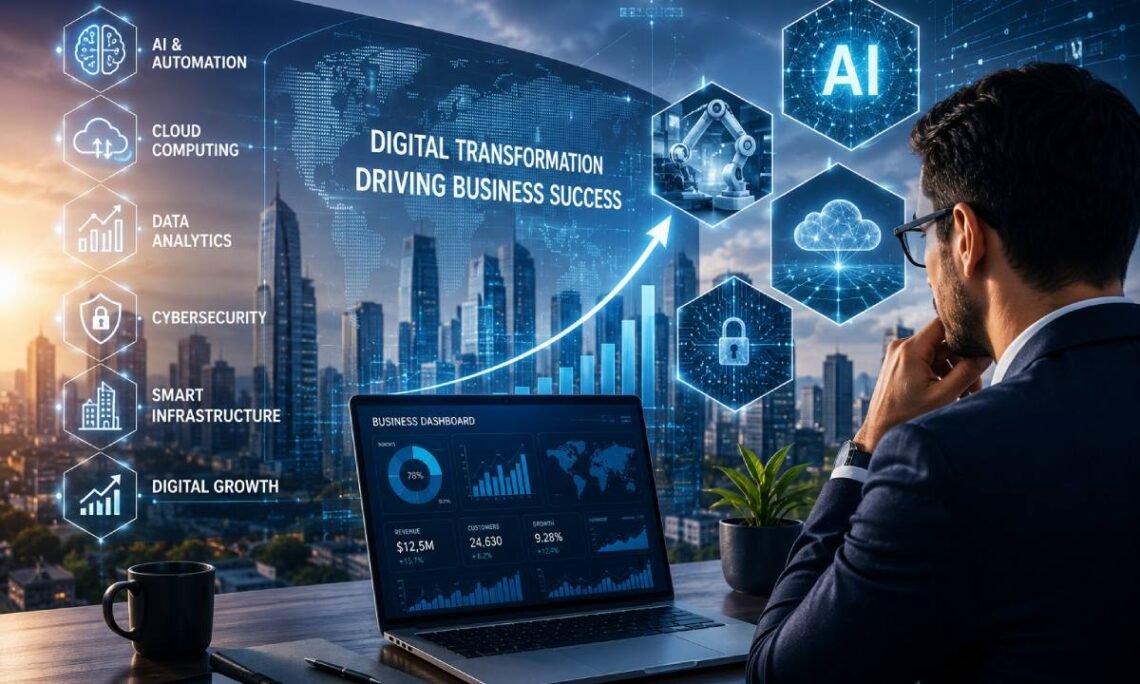
Technology has become one of the most important forces shaping modern business. Companies of every size are using digital tools to improve communication, automate repetitive work, understand customers, protect information, and develop new products and services.
The technology landscape is changing particularly quickly because artificial intelligence is becoming integrated into software, infrastructure, cybersecurity, robotics, and business operations. Gartner’s 2026 technology outlook identifies AI-native development platforms, AI supercomputing, multiagent systems, physical AI, digital provenance, and AI security platforms among the major strategic trends influencing organizations.
For businesses, the challenge is no longer simply adopting technology. It is choosing the right technology and using it effectively.
Artificial Intelligence Is Changing Business Operations
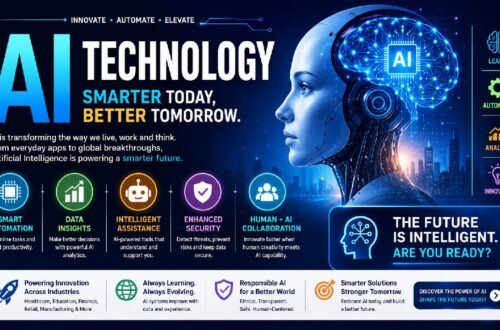
Artificial intelligence can help businesses perform tasks that previously required significant manual effort. Companies are using AI for customer support, data analysis, content creation, software development, marketing, research, and internal operations.
AI can process large amounts of information quickly and identify patterns that may be difficult to detect manually. This can help employees spend more time on tasks that require creativity, communication, judgment, and decision-making.
However, businesses should not adopt AI simply because it is popular. Technology should solve a genuine problem and provide measurable value.
AI Agents Are Creating New Possibilities
The development of AI agents is another important direction in business technology. Instead of simply responding to individual requests, AI systems can increasingly be designed to complete multiple steps within a workflow.
Multiagent systems can involve several specialized agents working together. One system might gather information while another analyzes it and another prepares an output.
Gartner identifies multiagent systems as one of its strategic technology trends for 2026, reflecting growing interest in more autonomous forms of software automation.
Businesses will still need appropriate controls and human oversight when deploying these systems, particularly when AI is connected to important business processes.
Software Development Is Becoming More AI Driven
Artificial intelligence is also changing the way software is created. AI-native development platforms can assist developers with coding, debugging, testing, documentation, and other tasks.
This can help development teams work more efficiently and potentially reduce the time required to create certain applications.
However, AI-generated code still needs to be reviewed. Developers need to consider security, performance, architecture, compatibility, and long-term maintenance.
The role of developers may increasingly involve guiding AI tools, reviewing their output, designing systems, and solving complex technical problems rather than writing every line manually.
Cybersecurity Is Becoming More Important
As companies become more dependent on digital systems, cybersecurity becomes increasingly important. Businesses store customer information, financial records, employee data, intellectual property, and operational information digitally.
At the same time, AI is being used by both defenders and attackers. Gartner’s 2026 cybersecurity research highlights the growing need for stronger oversight as agentic AI creates new security considerations and attack surfaces.
Businesses therefore need to consider cybersecurity as an ongoing process rather than a one-time technical project.
Strong passwords, access controls, software updates, employee awareness, backups, monitoring, and security policies can all contribute to a stronger security environment.
Cloud Technology Supports Business Growth
Cloud computing has become a foundation for many modern businesses. Companies can use cloud platforms for websites, applications, databases, storage, collaboration, analytics, and AI workloads.
One advantage of cloud technology is scalability. Businesses can adjust computing resources according to their requirements rather than relying entirely on fixed physical infrastructure.
Cloud services can also make it easier for distributed teams to collaborate and access business systems from different locations.
As AI workloads grow, cloud infrastructure will continue to play an important role in supporting advanced applications.
Data Is Becoming a Strategic Asset
Businesses generate large amounts of data through websites, applications, customer interactions, transactions, connected devices, and internal systems.
The value of data depends on how effectively it is collected, organized, protected, and analyzed.
AI systems can use business data to identify trends, support recommendations, improve forecasting, and help companies understand customer behavior.
However, poor-quality or incomplete data can produce unreliable results. Businesses therefore need strong data management practices before expecting advanced technology to deliver meaningful insights.
Physical AI Is Expanding Technology Beyond Screens
Technology is increasingly moving into the physical world. Robots, smart machines, drones, vehicles, industrial equipment, and other devices can combine sensors, software, and AI to respond to real-world environments.
Gartner includes physical AI among its major technology trends for 2026.
This could have applications across manufacturing, logistics, healthcare, agriculture, transportation, warehouses, and other industries.
Instead of following only predetermined instructions, intelligent machines may increasingly be capable of responding to changing conditions.
Digital Trust Is Becoming Essential
As AI-generated content becomes more common, businesses need ways to establish trust in digital information.
Digital provenance focuses on understanding the origin and integrity of digital content, software, and data. Gartner lists digital provenance among its 2026 strategic technology trends.
This can become particularly important for businesses dealing with financial information, customer communications, digital media, software, and AI-generated content.
Customers increasingly want to know whether information is genuine and whether businesses are handling their data responsibly.
Technology Is Improving Customer Experiences
Customers expect businesses to provide convenient and responsive experiences. Websites, mobile applications, chat systems, personalized recommendations, digital payments, and automated support can all contribute to better customer interactions.
AI can help businesses respond to common questions, recommend relevant products, analyze feedback, and provide assistance outside traditional working hours.
However, automation should not eliminate human support completely. Some situations require empathy, judgment, negotiation, or detailed explanation.
A combination of automation and human assistance can often provide a better experience.
Remote Work Depends on Better Technology
Digital collaboration tools have changed how many organizations operate. Employees can communicate through video meetings, messaging platforms, cloud documents, project-management systems, and other online tools.
Modern businesses increasingly need reliable networks and secure access systems to support these workflows. As AI and cloud applications become more demanding, enterprise networks are also being redesigned to support higher volumes of real-time data and digital collaboration.
This means connectivity has become an important part of business infrastructure.
Technology Can Support Small Businesses
Advanced technology is no longer available only to large corporations. Small businesses can access cloud software, digital marketing platforms, AI tools, online payment systems, customer relationship software, analytics tools, and automated workflows.
These tools can help smaller organizations compete more effectively.
A local business, for example, can use digital tools to manage customer inquiries, promote products, maintain an online presence, process payments, and analyze marketing performance.
The key is selecting tools that are affordable, practical, and relevant to the business.
The Importance of Human Skills
Technology can automate many repetitive activities, but human skills remain important. Creativity, leadership, communication, critical thinking, empathy, negotiation, and strategic decision-making are difficult to reduce to simple automated processes.
As AI becomes more capable, employees may need to learn how to work effectively with technology.
Continuous learning can help workers adapt to changing job requirements and understand new tools.
Businesses can also benefit from training employees rather than expecting technology alone to transform operations.
Choosing Technology Carefully
Companies often face pressure to adopt the newest technology immediately. However, not every emerging tool is appropriate for every organization.
Before adopting a new technology, businesses should consider the problem it solves, expected benefits, implementation costs, security requirements, employee training, integration with existing systems, and long-term maintenance.
A simple tool that solves a real problem can provide more value than an advanced system that employees rarely use.
Technology adoption should therefore be guided by business objectives rather than hype.
The Future of Business Technology
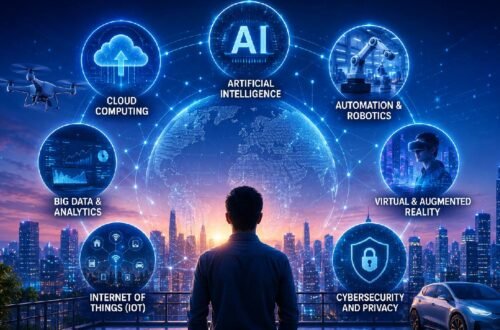
The future of business technology will likely involve greater integration between AI, cloud computing, cybersecurity, data systems, software development, and physical devices.
AI will increasingly become part of existing software rather than remaining a separate tool. Intelligent systems may automate more workflows, while physical AI could expand into industries that depend on machines and robotics.
At the same time, security, privacy, governance, and digital trust will become increasingly important.
Businesses that combine innovation with responsible technology management can be better prepared for this changing environment.
Conclusion
Technology is transforming modern businesses by changing how companies develop software, communicate with customers, analyze data, protect information, automate work, and operate physical systems.
Artificial intelligence and AI agents are becoming increasingly important, while cloud computing and digital infrastructure continue to provide the foundation for modern applications.
Cybersecurity and digital trust are equally important because increasingly connected businesses also face increasingly complex risks.
The most successful technology strategy is not necessarily the one that adopts the greatest number of tools. It is the one that uses technology to solve meaningful problems, improve customer experiences, support employees, and create sustainable business value.
Frequently Asked Questions
How is technology changing modern businesses?
Technology is helping businesses automate tasks, analyze data, improve customer service, develop software, communicate with employees, protect information, and create new products.
Why is AI important for businesses?
AI can help automate repetitive work, analyze information, generate content, support decisions, improve customer experiences, and increase productivity.
What are AI agents?
AI agents are systems designed to perform tasks or complete workflows with varying levels of autonomy. Multiple agents can also work together through multiagent systems.
Why is cybersecurity important?
Businesses depend heavily on digital systems and store valuable information electronically. Strong cybersecurity can help protect data, systems, customers, and business operations.
What is physical AI?
Physical AI involves intelligent software and AI systems being integrated into machines, robots, vehicles, drones, and other physical devices.
How does cloud computing help businesses?
Cloud computing provides flexible access to computing resources, storage, applications, databases, collaboration tools, and infrastructure without requiring every business to maintain all systems locally.
Why is business data important?
Business data can help organizations understand customers, identify trends, measure performance, forecast demand, and make better decisions when it is accurate and properly managed.
Will AI replace employees?
AI is likely to automate some tasks and change certain jobs, but many roles will continue to require human judgment, creativity, communication, leadership, and problem-solving.
How can small businesses use technology?
Small businesses can use AI tools, cloud software, digital marketing, online payments, customer management systems, analytics, websites, and automation to improve operations and reach customers.
What should businesses consider before adopting new technology?
Businesses should evaluate the problem being solved, expected benefits, cost, security, employee training, compatibility with existing systems, data requirements, and long-term maintenance.