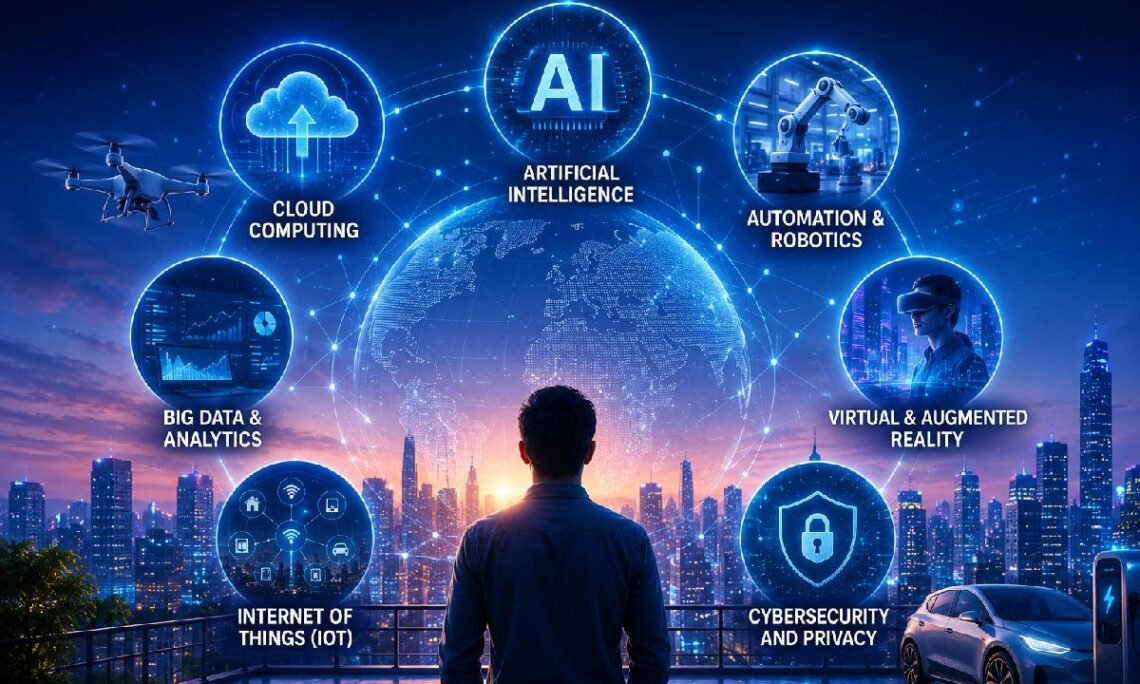
Technology is becoming more deeply connected to almost every part of modern life. Smartphones, cloud platforms, artificial intelligence, connected devices, automation, cybersecurity, and digital services are changing how people work, communicate, shop, learn, and manage everyday activities.
The technology industry is also moving beyond simple digital transformation. Artificial intelligence is increasingly being integrated into software, infrastructure, security systems, physical devices, and business processes. Gartner’s 2026 technology research identifies trends such as AI-native development, AI supercomputing, multiagent systems, physical AI, preemptive cybersecurity, and AI security platforms among the major developments shaping technology.
Artificial Intelligence Is Becoming Part of Everyday Technology
Artificial intelligence is no longer limited to specialized research environments. It is increasingly appearing inside applications, search tools, customer service platforms, productivity software, smartphones, and business systems.
AI can help analyze information, generate content, automate repetitive tasks, recognize patterns, and provide recommendations.
The next stage of AI development is increasingly focused on practical applications. Instead of using AI only to answer questions, organizations are exploring systems that can complete multiple steps and support complex workflows.
This could change how people interact with software by reducing the amount of manual work required for routine activities.
Multiagent Systems Could Change Automation
One emerging technology direction is the development of multiagent systems. These systems involve multiple AI agents working together to handle different parts of a larger task.
For example, one agent might analyze information, another could organize the results, and another could prepare an output. This approach could allow businesses to automate workflows that previously required several separate software tools.
Gartner lists multiagent systems among its strategic technology trends for 2026, reflecting the growing interest in coordinated AI systems.
However, effective implementation will require clear permissions, monitoring, security controls, and human oversight.
AI Is Moving Into the Physical World
Artificial intelligence is also moving beyond screens and software. Physical AI refers to intelligent systems that interact with the real world through machines, robots, vehicles, drones, and other devices.
Deloitte identifies the convergence of AI and robotics as a major technology trend, highlighting the growing movement of AI into physical environments.
In the future, intelligent machines could become more common in manufacturing, logistics, warehouses, transportation, healthcare, agriculture, and other industries.
The technology could help machines respond to changing environments rather than simply following fixed instructions.
AI Infrastructure Is Becoming More Important
Advanced AI systems require significant computing power. As organizations use more AI applications, the demand for specialized processors, data centers, networking infrastructure, storage, and efficient computing systems continues to grow.
Deloitte’s 2026 technology research highlights the growing importance of AI infrastructure and the need for organizations to rethink computing strategies as AI workloads expand.
This means the future of AI will depend not only on software models but also on the infrastructure that supports them.
Efficient computing will become increasingly important as businesses attempt to balance performance, cost, energy consumption, and scalability.
Cybersecurity Is Becoming More Complex
As technology becomes more advanced, cybersecurity challenges are also changing. Artificial intelligence can help security teams detect suspicious activity and analyze large amounts of information, but attackers can also use AI to improve their methods.
Google Cloud’s 2026 cybersecurity forecast warns that threat actors are expected to use AI to increase the speed, scale, and effectiveness of cyberattacks while defenders also use AI agents to strengthen security operations.
This creates an ongoing technology race between attackers and defenders.
Organizations will need to pay attention to identity management, access controls, monitoring, employee awareness, software security, and data protection.
AI Security Will Become a Core Requirement
As businesses adopt AI systems, protecting those systems becomes increasingly important. AI applications may have access to sensitive information, business processes, customer data, or internal systems.
Gartner includes AI security platforms and preemptive cybersecurity among its major 2026 strategic technology trends.
Businesses therefore need to think about security from the beginning rather than treating it as something that can be added after an AI system has already been deployed.
Strong permissions, monitoring, testing, and governance can help organizations manage technology-related risks.
Cloud Computing Continues to Support Digital Growth
Cloud computing remains an important foundation for modern digital services. Businesses use cloud platforms for data storage, software applications, collaboration, analytics, websites, and AI workloads.
Cloud systems allow organizations to scale resources according to demand without necessarily maintaining all infrastructure themselves.
As AI applications become more common, cloud platforms are also becoming important environments for developing and deploying intelligent software.
The relationship between AI and cloud computing is likely to become increasingly connected as organizations build more data-intensive applications.
Edge Computing Can Bring Technology Closer to Users
Not every computing task needs to happen in a distant data center. Edge computing allows certain processing activities to take place closer to where data is generated.
This can be useful for applications where speed and responsiveness are important.
Connected vehicles, industrial systems, smart cameras, healthcare equipment, and other devices may benefit from processing information closer to the source.
Edge computing can also reduce the amount of information that needs to travel continuously to centralized systems, depending on how an application is designed.
Smart Devices Are Becoming More Connected
The Internet of Things continues to connect physical devices to digital systems. Smart watches, home appliances, security cameras, vehicles, industrial equipment, and other devices can collect and exchange information.
When combined with AI, connected devices can become more useful because software can analyze data and identify patterns.
Smart homes, for example, can use sensors and connected devices to manage lighting, temperature, security, and other functions.
However, connected devices also create additional security considerations because every connected device can become part of a larger digital environment.
Technology Is Changing Software Development
Software development is also being transformed by AI. AI-native development platforms can help developers generate code, analyze errors, create documentation, test applications, and accelerate certain development tasks.
Gartner lists AI-native development platforms as a major technology trend for 2026.
This does not mean traditional programming knowledge is becoming irrelevant. Developers still need to understand architecture, security, testing, performance, databases, and business requirements.
Instead, AI can become another tool that helps developers work more efficiently.
Digital Trust Is Becoming Essential
As AI-generated content and automated systems become more common, users need greater confidence in the technology they interact with.
Digital provenance, which Gartner includes among its 2026 strategic technology trends, focuses on understanding the origin and history of digital content and information.
This can become increasingly important for identifying whether digital content is genuine, modified, automatically generated, or produced by a particular source.
Trust will matter not only to consumers but also to businesses, governments, financial institutions, and technology providers.
Technology Skills Are Becoming More Valuable
The rapid development of technology is creating demand for people who can understand and use new tools effectively.
Technical skills such as programming, cybersecurity, cloud computing, data analysis, AI development, and automation remain valuable. At the same time, communication, creativity, critical thinking, and problem-solving continue to be important.
As technology handles more repetitive tasks, people may increasingly focus on decisions that require context, judgment, creativity, and human understanding.
Continuous learning can therefore become an important part of professional development.
Technology and Sustainability
Technology can also contribute to more efficient use of resources. Smart energy systems, connected sensors, intelligent transportation, data analytics, and automation can help organizations monitor and optimize resource consumption.
At the same time, advanced computing infrastructure requires significant energy and resources. As AI adoption grows, businesses will need to consider efficiency alongside performance.
Developing more efficient hardware, software, and data center infrastructure can therefore become an important part of technology planning.
The Future of Technology
The future of technology is likely to be defined by greater integration. AI will increasingly connect with cloud computing, robotics, cybersecurity, software development, connected devices, and data systems.
Rather than operating as isolated technologies, these systems may increasingly work together.
Businesses that adopt technology successfully will likely focus not simply on purchasing the newest tools but on solving genuine problems, protecting information, measuring results, and creating useful experiences.
Conclusion
Technology is entering a period of rapid transformation. Artificial intelligence is becoming more practical, multiagent systems are expanding automation, AI is moving into physical devices, and cybersecurity is becoming increasingly important.
Cloud computing, edge computing, connected devices, AI-native software development, and digital trust are also contributing to the changing technology landscape.
The future will not be defined by one technology alone. Instead, different technologies will increasingly work together to create more intelligent and connected systems.
For individuals and businesses, adaptability will remain essential. Learning new skills, understanding emerging technologies, protecting digital information, and focusing on practical value can help people make better use of the opportunities created by technological change.
Frequently Asked Questions
What are the biggest technology trends?
Major trends include artificial intelligence, multiagent systems, physical AI, AI infrastructure, cloud computing, cybersecurity, connected devices, AI-native software development, and digital trust.
How is AI changing technology?
AI is being integrated into software, business processes, smartphones, security systems, robotics, customer service, data analysis, and many other areas.
What are multiagent AI systems?
Multiagent systems involve multiple AI agents working together to complete different parts of a larger task or workflow.
What is physical AI?
Physical AI refers to artificial intelligence being integrated into machines and devices that interact with the physical world, including robots, vehicles, and smart equipment.
Why is cybersecurity becoming more important?
As organizations become more dependent on digital systems, cyber threats can have greater consequences. AI is also being used by both attackers and defenders, creating new security challenges.
What is AI-native software development?
AI-native development involves using AI as an integral part of the software development process to assist with coding, testing, documentation, analysis, and other development activities.
Why is cloud computing important?
Cloud computing provides scalable infrastructure for applications, data storage, collaboration, analytics, and increasingly AI workloads.
What is edge computing?
Edge computing processes certain information closer to where it is generated rather than sending everything to a centralized data center.
Why is digital trust important?
As digital content and AI-generated information become more common, users need greater confidence about where information comes from and whether it has been modified or automatically generated.
How can people prepare for future technology?
People can stay prepared by developing digital skills, learning about AI and cybersecurity, keeping up with emerging technologies, improving problem-solving abilities, and maintaining a habit of continuous learning.