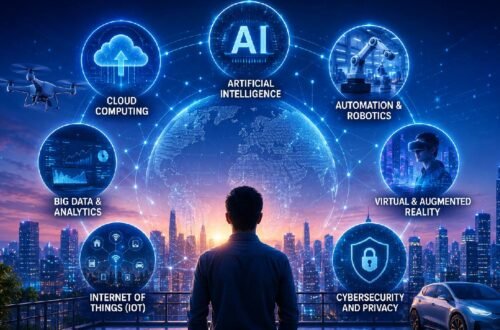
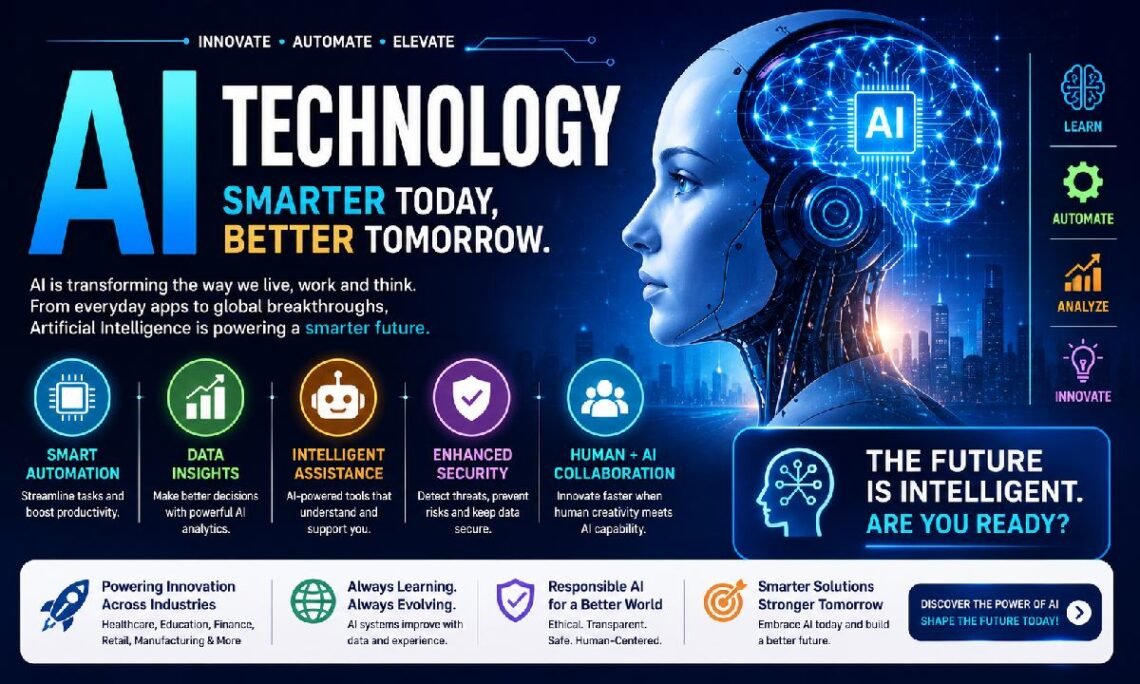
Artificial intelligence, commonly known as AI technology, has moved from being a futuristic concept to becoming an important part of everyday life. From smartphones and search engines to healthcare, finance, education, marketing, manufacturing, and entertainment, AI is increasingly being used to automate tasks, analyze information, and support decision-making.
What makes AI particularly powerful is its ability to process large amounts of data and identify patterns that may be difficult for humans to recognize manually. As the technology continues to develop, businesses and individuals are finding new ways to use AI for productivity, creativity, problem-solving, and innovation.
Understanding AI technology is therefore becoming increasingly important for anyone interested in the future of technology and digital transformation.
What Is AI Technology?
AI technology refers to computer systems and software designed to perform tasks that traditionally require human intelligence. These tasks can include understanding language, recognizing images, identifying patterns, making predictions, generating content, and solving complex problems.
AI systems can be trained using large amounts of data and sophisticated algorithms. Depending on their design, they can learn patterns from information and use those patterns to produce predictions, recommendations, classifications, or generated content.
AI does not necessarily work exactly like the human brain. Instead, different AI systems use different computational methods to accomplish specific objectives.
How Does Artificial Intelligence Work?
AI systems generally depend on data, algorithms, computing power, and models.
Data provides examples from which an AI system can identify patterns. Algorithms provide the mathematical and computational methods used to process that information. Machine-learning models can then use those patterns to perform particular tasks.
For example, an image-recognition system can be trained using large numbers of labeled images. After training, the system may be able to identify objects or characteristics in new images.
More advanced AI systems can process text, images, audio, video, and other forms of information.
What Is Machine Learning?
Machine learning is one of the most important areas of AI.
Instead of programming every possible response manually, machine-learning systems can learn patterns from data. The model is trained using examples and then evaluated on new information.
Machine learning is already used in recommendation systems, fraud detection, spam filtering, predictive analytics, search technologies, and many other applications.
The quality of the results depends heavily on the quality and relevance of the data, the model, and the way the system is trained and evaluated.
What Is Generative AI?
Generative AI is a category of artificial intelligence designed to generate new content based on learned patterns.
Depending on the system, generative AI can create text, images, audio, video, software code, and other forms of content.
This technology has changed how people approach creative and professional tasks. Writers can use AI for brainstorming, developers can use it for coding assistance, and designers can explore concepts more quickly.
However, generated content should still be reviewed carefully because AI systems can produce inaccurate, incomplete, biased, or misleading information.
How AI Is Changing Businesses
Businesses across different industries are adopting AI to improve efficiency and understand their customers.
AI can help companies analyze large datasets, automate repetitive processes, personalize customer experiences, detect unusual activity, and support employees with information.
For example, an online retailer can use AI-powered recommendations to suggest products based on customer behavior. A financial company can use machine learning to identify potentially unusual transactions. A marketing team can use AI to analyze campaign performance and generate content ideas.
The goal is not always to replace human workers. In many situations, AI works as an additional tool that helps employees perform tasks faster.
AI Technology in Healthcare
Healthcare is another area where AI technology has significant potential.
AI can assist with medical image analysis, data processing, research, administrative workflows, and patient-support systems. Researchers are also exploring AI for drug discovery and identifying patterns in large biological datasets.
However, healthcare is a high-stakes field. AI-generated recommendations should not automatically be treated as medical diagnoses or professional advice. Human expertise, clinical validation, privacy protection, and regulatory requirements remain essential.
AI in Education
AI is changing the way students and educators interact with technology.
AI-powered tools can help students practice concepts, generate explanations, organize information, and receive personalized learning assistance. Teachers can also use technology to create educational materials and support certain administrative tasks.
The most effective use of AI in education is likely to combine technology with human teaching rather than completely replacing teachers.
Critical thinking remains essential because students need to understand, evaluate, and verify information instead of accepting AI-generated answers without question.
AI in Finance
Financial institutions have been using automated data analysis and machine learning for many years.
AI can help identify unusual transactions, analyze financial patterns, automate certain customer-service processes, and support risk assessment.
Because financial decisions can have significant consequences, AI systems need strong controls, accurate data, security measures, and appropriate human oversight.
AI in Marketing
AI has become an increasingly useful tool for modern marketing.
Marketing teams can use AI to analyze audience behavior, identify patterns, personalize communication, generate content ideas, optimize campaigns, and automate repetitive workflows.
AI can also help businesses understand which content formats and messages are performing well.
However, successful marketing still requires creativity, brand understanding, emotional intelligence, and strategic thinking. AI can support these activities, but it does not eliminate the need for human judgment.
AI and Automation
Automation is one of the most practical applications of AI technology.
Traditional automation typically follows predefined rules. AI-powered automation can be more flexible because machine-learning systems can analyze information and respond to patterns.
For example, an AI system may categorize customer messages, identify frequently asked questions, summarize documents, or route requests to the appropriate department.
This can reduce repetitive workloads and allow employees to focus on more complex responsibilities.
AI in Customer Service
Many businesses now use AI-powered chatbots and virtual assistants to handle common customer questions.
These systems can provide information around the clock and help customers with routine requests. More advanced systems can understand natural language and maintain context across multiple interactions.
However, customers should still have access to human support when an issue is complex, sensitive, or outside the AI system’s capabilities.
AI and Cybersecurity
AI can also play an important role in cybersecurity.
Security systems can analyze large volumes of network activity and identify unusual patterns that may indicate potential threats. Machine learning can help organizations detect suspicious behavior and respond more quickly to certain security events.
At the same time, AI can also be misused by attackers. This creates an ongoing technological race in which security professionals need to continuously improve detection and defense systems.
AI in Transportation
Transportation is another field being influenced by artificial intelligence.
AI can be used for route optimization, traffic analysis, predictive maintenance, driver-assistance systems, and logistics planning.
Companies can analyze large amounts of transportation data to identify efficient routes and predict potential maintenance requirements.
Autonomous driving remains a much more complex challenge because vehicles must interpret changing environments and make decisions in real time while meeting demanding safety requirements.
AI in Manufacturing
Manufacturing companies can use AI to improve production processes and identify potential equipment problems.
Predictive maintenance systems can analyze sensor data to identify patterns associated with equipment failure. This can help companies schedule maintenance before a serious breakdown occurs.
AI can also support quality inspection, inventory management, supply-chain planning, and production optimization.
Advantages of AI Technology
One of the biggest advantages of AI is its ability to process large amounts of information quickly.
AI can also automate repetitive tasks, support decision-making, identify patterns, improve personalization, and help organizations operate more efficiently.
For individuals, AI tools can provide assistance with research, writing, organization, brainstorming, learning, and many other activities.
The value of AI ultimately depends on how responsibly and effectively it is implemented.
Challenges of Artificial Intelligence
AI technology also creates important challenges.
One major issue is accuracy. AI systems can produce incorrect information or make unreliable predictions, particularly when they are given poor-quality data or asked to perform tasks outside their intended capabilities.
Privacy is another important concern because AI systems may process large amounts of personal or organizational information.
Bias can also become a problem if the data used to train a system contains historical or structural biases.
Security, transparency, accountability, copyright, employment changes, and ethical considerations are additional areas that require attention.
Will AI Replace Human Jobs?
The impact of AI on employment is more complicated than simply saying that AI will replace all jobs.
Some repetitive tasks are likely to become increasingly automated, while other jobs may change as workers begin using AI as part of their daily workflow.
New roles can also emerge around AI development, implementation, governance, data management, cybersecurity, and human-AI collaboration.
The ability to learn new skills and adapt to changing technology is likely to become increasingly valuable.
AI and the Future of Work
The workplace of the future may involve greater collaboration between humans and AI systems.
Employees may use AI assistants to summarize information, analyze documents, generate initial drafts, organize tasks, or explore possible solutions.
Human workers can then focus on responsibilities requiring judgment, creativity, communication, leadership, empathy, and accountability.
This model could make AI a productivity tool rather than simply a replacement technology.
The Importance of Responsible AI
Responsible AI means developing and using artificial intelligence with attention to safety, fairness, privacy, transparency, accountability, and human oversight.
Organizations need to understand how their AI systems work, what data they use, what risks they create, and how errors will be handled.
Responsible implementation is particularly important when AI is used in areas such as healthcare, finance, employment, education, and public services.
What Skills Are Important in an AI-Driven World?
People do not necessarily need to become AI engineers to benefit from artificial intelligence.
Digital literacy, critical thinking, data awareness, communication, creativity, problem-solving, and the ability to evaluate information are increasingly valuable skills.
Understanding how AI works at a basic level can also help people recognize its strengths and limitations.
Learning how to work effectively with AI may become an important professional skill across many industries.
The Future of AI Technology
AI technology is likely to continue evolving rapidly. Future systems may become more capable of processing multiple types of information, interacting naturally with users, performing complex workflows, and supporting specialized professional tasks.
Businesses are likely to continue experimenting with AI applications, while governments and organizations develop frameworks for responsible use.
The future of AI will not depend only on technological progress. It will also depend on how society chooses to manage the opportunities and risks created by increasingly capable systems.
Frequently Asked Questions About AI Technology
What is AI technology?
AI technology refers to computer systems designed to perform tasks associated with human intelligence, such as understanding language, recognizing patterns, analyzing data, making predictions, and generating content.
What is the difference between AI and machine learning?
Artificial intelligence is the broader field of creating systems capable of intelligent behavior. Machine learning is a major approach within AI that allows systems to learn patterns from data.
What is generative AI?
Generative AI creates new content such as text, images, audio, video, or code based on patterns learned from training data.
How is AI used in everyday life?
AI can be found in search engines, recommendation systems, smartphones, navigation applications, spam filters, digital assistants, online shopping platforms, and many other technologies.
Can AI replace humans?
AI can automate certain tasks and change the way jobs are performed, but many responsibilities still require human judgment, creativity, communication, empathy, and accountability.
Is AI technology safe?
AI can be useful when designed and deployed responsibly, but it also creates risks related to privacy, security, bias, misinformation, and incorrect outputs. Appropriate safeguards and human oversight are important.
How does AI help businesses?
AI can help businesses analyze data, automate repetitive work, personalize customer experiences, identify patterns, improve efficiency, and support decision-making.
Can small businesses use AI?
Yes. Small businesses can use AI for customer support, content creation, marketing analysis, workflow automation, research, scheduling, and other activities depending on their needs.
Is AI useful for education?
AI can support personalized learning, research, explanations, educational content creation, and administrative tasks. Students and educators should still verify important information and maintain critical thinking.
What are the disadvantages of AI?
Potential disadvantages include inaccurate outputs, privacy concerns, biased results, security risks, excessive dependence on automation, job disruption, and misuse of the technology.
What skills are needed for the AI future?
Digital literacy, critical thinking, problem-solving, creativity, communication, data awareness, and the ability to understand and evaluate AI-generated information can all be valuable.
What is the future of AI?
AI is expected to become more integrated into software, business operations, education, healthcare, manufacturing, transportation, and everyday digital experiences. Its future development will depend on both technological innovation and responsible use.
Conclusion
AI technology is transforming how people work, learn, communicate, create, and solve problems. Its applications range from simple automation to sophisticated systems capable of processing text, images, audio, and complex datasets.
The technology offers significant opportunities, but it also comes with challenges involving accuracy, privacy, security, bias, employment, and responsible use.
Rather than viewing AI simply as a replacement for human intelligence, it is useful to consider how humans and intelligent systems can work together. When used thoughtfully, AI can become a powerful tool for improving productivity, supporting innovation, and solving problems across industries.